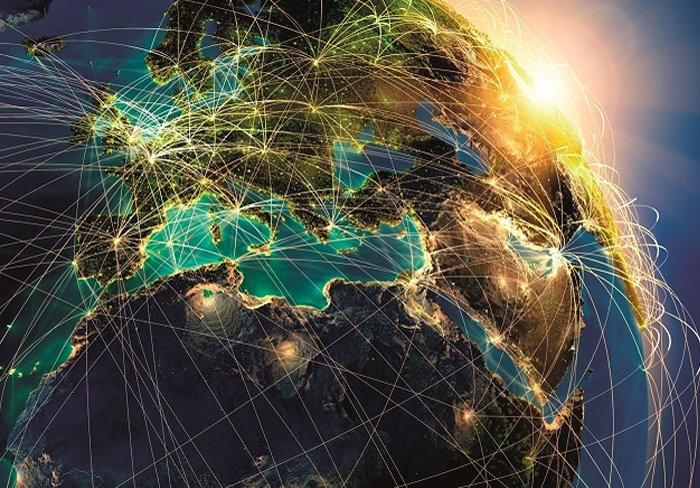
The world today is a global village. Globalisation as a concept and phenomenon has become part of our life. As a term, globalisation has settled in different languages across the world and become a universal word for:
the speedup of movements and exchanges (of human beings, goods, and services, capital, technologies or cultural practices) all over the planet, thanks to advances in transportation and communication technology.
So, how does globalisation affect us? Individuals, organisations, companies, and institutions? The natural consequence of the globalisation trend at the individual and as well as organisational level is internationalisation.
Internationalisation is all about increasing one’s visibility and footprint beyond the national context and market. For companies, it means getting involved in the international markets and adapting their products and services to the needs of global customers. For individuals, it is about the ability to participate and contribute to activities happening in a multilingual and multicultural environment, both professionally and privately.
It goes without doubt that none of the international socialising, networking, or business making would be possible without a common medium of communication – a lingua franca.
Here comes the English language – the first truly global language in human history. Spreading so fast and successfully that already today, most people in the world who use and speak English are non-native speakers.
What we tend to forget or rather lack to acknowledge is that, on the language level, internationalisation equals Anglicisation. By adopting English as a global language we also adopt the Anglo-perspective on topics we approach. English, just like any other language, has evolved in a particular cultural, geographical, and historical context, therefore, it reflects a linguistic worldview, shaped by the experiences, beliefs, ideas, and perceptions of the Anglo community.
Currently, the convergence on the Anglo-American tradition and culture can be observed across all spheres of human life, starting from business, through education and research, ending on leisure activities. Moreover, it can also be observed on a conceptual level, which some scholars view as a problem, because it may be an obstacle to objectivity in research and academia.

Prof. Anna Wierzbicka, the author of the book “Imprisoned in English” talks about a blind spot in the social sciences and humanities, being locked in a conceptual cage due to the dominance of English in academia. Sadly, most scholars in these fields are not aware of the need to break away from this framework to reach a more universal, culture-independent perspective on things.
Nowadays, the ability to operate in English is an undebatable must, not only for individuals or organisations wanting to expand their activity outside the national borders but also for those who remain in the local market.
That being said, it is worth asking a question – is the proficiency in English truly sufficient to fully embrace the international experience?
It seems that the more we push for English as a default medium of communication, the stronger the need to preserve and cultivate indeginous languages, especially the low-profile languages – “the endangered species”. As a result, language is caught between two conflicting trends, on one hand, there is a growing Anglicisation and unification trend and, on the other hand, attempts to develop multilingual competence and revive and protect heritage languages.
At the same time, the language question seems to be overlooked in the public debate about diversity, inclusion, and unconscious bias. We tend to focus on gender equality, racial issues, but in fact, what comes first is the ability to share the same communication code and pattern. Research shows that foreign language or accent prevails over race in guiding people’s social preferences.
So how should we approach the conflict between the increasing Anglicisation trend in a highly multilingual setting? We definitely need more research in multilingual studies in order to inform policymaking in pedagogies, education, and research as well as raise general awareness. As regards English, the first truly global language in human history, no one owns it anymore. The international users of English significantly outnumber the English native-speakers. It looks like we have reached a moment when we will have to rethink and redefine current norms and standards, not only those that exist in textbooks but also in our heads.
With the current rapid pace of migration and integration processes in the world, resulting in cultural and linguistic interconnectedness, we need to move away from the monolingual norms of native-speakerism and strive to establish truly international norms based on linguistic diversity and inclusivity.
 LANGOLUX
Unfortunately, those of us who grew up in most public schools here in the United States usually do not get the opportunity to study indigenous or world languages until the secondary grades, if at all! Far too many of us end up with a “monolingual” orientation to the world, thus becoming the stereotypical monolingual Americans who cannot figure out why it’s beneficial to learn multiple languages. I remember my fifth-grade teacher, who used to teach us oral French! As a kid I loved this exposure to another language, and wondered why we could not receive instruction every day! When I attended junior high school, only the students in the top two tracks at school could learn ALM French, which they could continue at our high school. Although our high school offered four languages at that time–French, German, Latin, Spanish–we typically could study only one of these per quarter. I believe all American schools should offer two-way bilingual instruction, starting at the pre-school level. The United Nations International School in New York offers multiple language tracks, starting with the kindergarten level. For us North Americans,
French, Spanish and Portuguese are useful languages for the Western Hemisphere. However, we should be exposed to more Asian, Indigenous and African languages in addition to the various languages found in the European Union countries. The “Anglicization effect” could be eliminated if more comprehensive dual-immersion foreign language instruction could be implemented nationwide in Anglophone countries in our public/state
schools, K-12. Then we Anglophones could communicate with the rest of the planet, without forcing everyone to use only “global English” to exchange ideas and research!
LikeLiked by 1 person