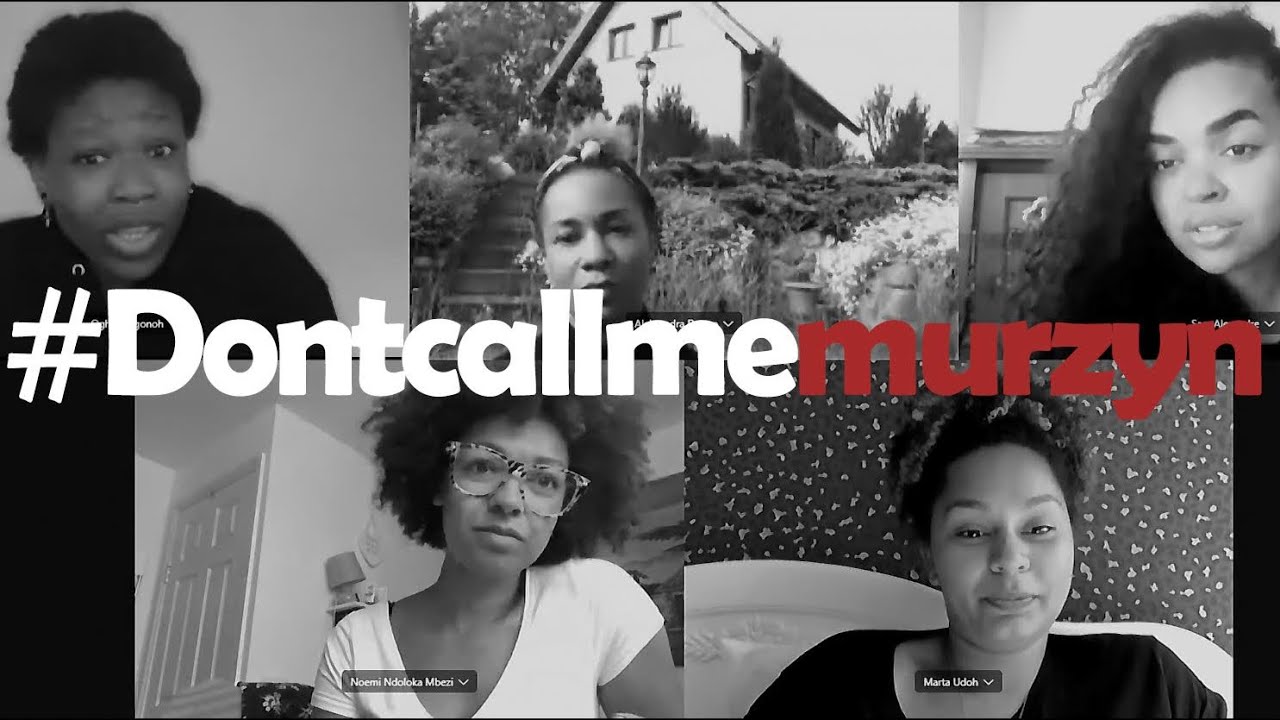
The ripple effect of the recent “Black Lives Matters” protests, sparked by the killing of George Floyd, has spread beyond the borders of the United States. In Poland, it resulted in starting a public campaign “Don’t call me Murzyn”.
I first saw the hashtag #DontCallMeMurzyn in my Facebook feed and I immediately thought: “What? Why? What’s wrong with this totally neutral word?”
It must be another example of the omnipresent Anglicization of the world we live in? It is probably a careless translation of the English Negro, without taking into consideration that the socio-cultural roots of both words are significantly different.
After all, Poland was not a colonial superpower that participated in the slave business. Therefore, the structural racism has never made its footprint on the tacit meaning of the race-related vocabulary. At the same time, it doesn’t mean that there is no racism in Poland, of course there is, just like anywhere else, it is just different and it is essentially rooted in the fear of the unknown and the otherness.
The word Murzyn came into Polish by borrowing the German word Mohr, derived from Latin Maurus, similarly to the English word ‘moor‘.
If Murzyn has become more offensive than it used to be, then, what about an alternative? It seems that most people would think of czarny/a/e (m/f/n) to be used instead. It means black and normally it is an adjective but in this particular case it could work as a noun too. However, it sounds quite harsh and even worse than Murzyn in Polish. No one would say czarny mężczyzna to refer to a black man, they would rather go for czarnoskóry mężczyzna (a black-skinned man) or, to be truly politically correct, they would say ciemnoskóry mężczyzna (a dark-skinned man). But, these are quite lengthy expressions, which would make communication feel awkward, especially in informal speech.
I decided to inquire what the national authority for the Polish language has to say about it, and it turned out that Prof. Jerzy Bralczyk, just like me, finds this word neutral. However, Prof. Bralczyk, just like me too, remembers well the times when a black person would be a sensation in the Polish streets. And this probably made us unaware of how racial discrimination feels like.
It looks like the transformation of the Polish society in recent years has also had its (unfavorable) impact on the word Murzyn. After opening up the country’s borders to the world, society has become much more diverse, also as regards the skin color of new tourists and citizens. This, unfortunately, led to more acts of discrimination, placing the word Murzyn at the center of commonly used insults. Some of them being as horrific as: “F**k the Murzyn“, “Where did a Murzyn get cash for such a nice car?”
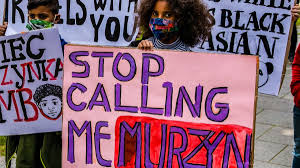
According to the Dictionary of the Polish Language, Murzyn means somebody with a black skin. However, informally, it can also mean:
- Somebody anonymously doing work for somebody else;
- Somebody with a dark brown tan;
- A hard working person forced to do hard labour.
That is why, in Polish, we find such idiomatic expressions featuring the M-word as “the white Murzyn” meaning literally a slave, or “the Murzyn did his thing, now the Murzyn can go”. Another one is “100 years behind the Murzyns“, used to describe something that is uncivilized and backward.
Although these expressions have existed in the Polish language for many years, and are highly offensive, it seems that this word retained its neutral character. Or is it rather a skewed perception typical for a white Polish person? I admit that, while growing up in Poland I hardly ever heard these expressions around me. Therefore, to me Murzyn was simply a term describing a black man. At the same time, there’s a great chance that I didn’t see anything wrong in it due to the fact that I was living a life of “blissful ignorance” as regards the racial discrimination. In Poland that I remember from my childhood and youth this social issue was simply irrelevant.
Interestingly enough, it seems that the derogatory character of the concept Murzyn focuses primarily on its masculine form. While doing research for this post I watched a discussion between Prof. Bralczyk and some Afropolish women (see the picture on top of the page). They talked about the campaign “Don’t call me Murzyn” and the differences of perception of Murzyn across the Polish society. As a matter of fact, none of them, throughout the whole discussion, referred to the female variant Murzynka when talking about their deplorable experiences involving this word. Every time, they were insulted by someone, it seems that the masculine form Murzyn would be involved.
For those who are not familiar with the Polish grammar, Polish is a highly inflected language (very rich in conjugation and declension) and has three grammatical genders (f/m/n). The gender is marked on pretty much everything: pronouns, numerals, nouns, verbs and adjectives. A black female person is Murzynka, a black male person – Murzyn, a child – Murzynek, and a baby – Murzyniątko. An expression piękna Murzynka (a beautiful Murzynka) is nothing more, or above all, a genuine compliment. According to the current convention of the Polish language, it can’t be viewed negatively or offensive. As far as alternative options are concerned, piękna czarnoskóra kobieta (a beautiful black-skinned woman) or a piękna ciemnoskóra kobieta (a beautiful dark-skinned woman) sound rather awkward and feel unnatural for a native speaker of Polish. To be honest, przystojny Murzyn (a handsome Murzyn) sounds quite flattering in Polish too.
It looks like that thanks to the nuances that the grammatical gender introduces to the Polish names, Murzynka managed to escape the derogatory overtone. And the fact that there aren’t any offensive expressions featuring Murzynka in the Polish language definitely helped.
I must say, though, that it is not entirely the case for Murzynek or Murzyniątko. On one hand, they sound really cute as they are diminutive forms of Murzyn, but at the same time carry a condescending tone. It is probably partly due to the fact that the former one is associated with the traditional children’s poem by Julian Tuwim “Murzynek Bambo”, which is written in a friendly tone, but, involuntarily, it can be offensive. For example, it speaks about a murzyńska czytanka (a Negro reader), or that Bambo doesn’t want to take a bath because he is afraid of turning white.

Murzynek (spelled with small letters) is also a name for a traditional brownie-type cake in Poland. I wouldn’t be surprised if in some years time we will have come up with a more politically correct term.
These gender-related nuances and their effect on meaning made me think about a study carried out by Lera Boroditsky’s lab. The study showed that, in gendered languages, people tend to choose adjectives according to the grammatical gender of the noun they want to modify. So for example, a bridge in German is feminine, therefore, people would choose more feminine-like adjectives, for instance beautiful or elegant, whereas in languages where bridge is masculine they would rather go for strong or solid. Apparently, the study has not been fully published, because it was not replicated successfully to confirm the hypothesis. Nevertheless, taking the Polish names Murzyn, Murzynka, Murzynek, Murzyniątko as an example, one can clearly see that there are differences between them. They sound different, they carry different emotional charge, their use highly depends on people’s motivations. The grammatical gender is definitely relevant in this case, thus, potentially, it influences cognition.
The campaign “Don’t call me Murzyn” shows that there should always be room, whenever there’s a need, for discussion about language and our motivations when we use it. People who feel oppressed or offended by some words should have their voices heard in order to raise awareness among those, who remain oblivious to the harm. That being said, we cannot mandate language by imposing what we should and what we shouldn’t say. Even if we did it, it would probably be counter-productive as it would turn some words into taboos. And we all know how tempting taboos are.
As Prof. Jerzy Bralczyk says every word, even the most filthy one, has its place in language. However, it is up to us how we will use them. And, as it is with everything that we do in life, respect, empathy, and kindness is always a good place to start.
 LANGOLUX